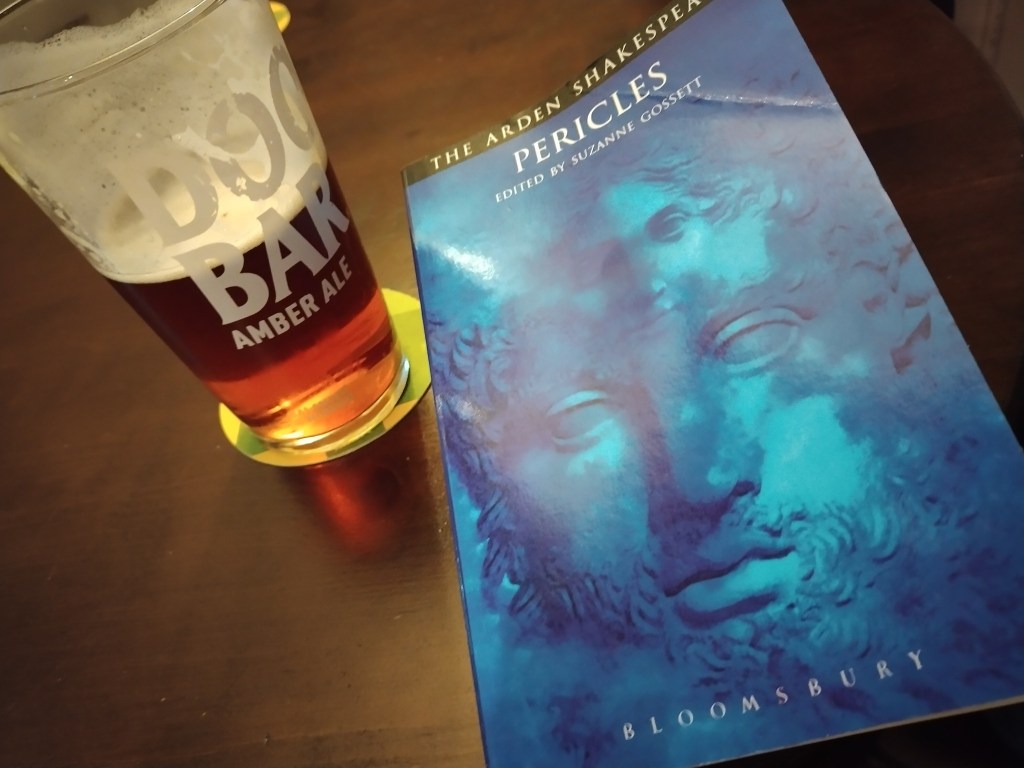
When someone asks me why I like to organise Shakespeare readings in pubs, I tell them that I want to get more people reading and enjoying the plays. I tell them the mission of Chilled Shakespeare is to free the Bard from the schools, colleges and universities where we study him as an academic topic.
But the reason I started doing it was that I was curious about Shakespeare myself. I knew that Shakespeare is considered the greatest poet in the English language, but nothing more. I also knew that I struggled to read a single play on my own without losing concentration at every unknown word or difficult phrase. Chilled Shakespeare was a way to get over that.
First and foremost, I’ve learnt a great deal about the works of Shakespeare, but I’ve learnt a lot more than that.
Here’s a run-down of things that come to mind, and this blog intended as sort of checklist for setting up future events elsewhere.
Shakespeare plays are intended to be heard not read
We have very little idea what it was like going to see a play in the 16th or 17th century but contemporary sources often talk about “hearing” a play rather than seeing one. There’s debate about what that actually means, did people go just to listen? Either way, hearing a play is significantly easier than reading one, and it’s a lot more convenient that going to see a play.
When you’re reading in a group down the pub, that’s exactly what happens and it’s the listeners that benefit the most. Reading out loud, you can’t stop and think about a difficult bit. Everyone else is listening so you just read it and move on. That’s ideal because then a lack of understanding doesn’t interrupt the flow of the text. Most of the time you can still see what’s going on from the context. If you get 75% of it, you’ll enjoy the story. That worked for me and now we’ve read almost all Shakespeare’s plays, many of them several times. When you read in a group, people share their knowledge and observations which is invaluable.
It’s difficult organising who reads which parts
This is one of the hardest parts of organising a play reading, especially if you’re not familiar with the text beforehand.
It’s horrible to “auction” off the parts at the beginning. Asking “who wants to read… Hamlet?” almost always results in an awkward silence. Some folks want to read a big part, some want to read a small part, but from my experience very few people will stand up and say what they really want to do.
The challenge is finding the good readers to take on the big parts and keep it interesting. If someone has a long speech, it can be hard to listen to if they keep stumbling over the words but that’s just part of it. It’s often those people we want to appeal to.
The best way around this I’ve found is to walk around the individual tables, talk to people and find out who they are and ask them on a one-to-one basis what they’d like to do. Assigning a scene to a table seems to work well.
Try to make an event of it rather than a simple book club
The thing with play reading clubs is that they can seem dull to anyone on the outside looking in, and that’s no way to build good attendance.
The most fun and memorable evenings are when you make an event of it. I like to do an introduction that tells people what’s going on, what the mission is, why we’re running the club in the first place. It gives people a sense of occasion, even if it’s just “Hello ladies and gentlemen and welcome to Chilled Shakespeare here at the Lamb Steyne, Bognor Regis, the cultural centre, literary hot spot of West Sussex, for one night every two weeks.”
Other techniques that work well are to choose a nice poem by another author -and read that at the beginning, and another at the half-time break. I like to ask someone else to read it, so it encourages more people to get involved. We need to make an event of the evening, but it mustn’t become the “Richard Baldwin show”.
Having live music also works very well during the half time break. This doesn’t have to be a proper recital or performance, just a bit of background music while folks go to the bar.
Read the play in advance, study it – but don’t be a show off
The most successful play readings I’ve ever organised have been the ones where I’ve had a detailed knowledge of the play in advance. It helps you in so many ways. First of all, it makes distributing the parts much easier if you know which are the big parts and which are one liners, who are the baddies and who are the goodies, who is about to die in the next scene.
If you know what’s going on (even roughly) you can organise the whole evening much better. You’ll know when’s a good time to take a break, where’s a good place to stop, and you’ll be able to explain to people what’s going on, or why a character is acting in a certain way.
That final point is balancing act, because what you mustn’t do is appear to show off, make it dull by labouring some obscure point, or remind people of their school days, studying the text. I also try not to contradict anyone if they say something I don’t agree with, and I will never correct someone’s pronunciation, unless they ask first. Organising Chilled Shakespeare, you need a detailed knowledge of the play, but you gotta keep that knowledge to yourself.
Consider the lighting
This one is not immediately obvious, but absolutely vital to a successful evening. You might be tempted to have low lighting because it’s atmospheric, and many pubs have low lighting anyway. This is potentially disastrous because it makes it difficult to read, especially for people who wear glasses.
I’ve seen really great readers, confident people who know the plays well, struggle and get frustrated because of the lighting in the pub. The situation is compounded by small text in some editions of Shakespeare. This is also more of an issue in the winter months when it gets dark earlier.
On one occasion we had a power cut during a reading the whole pub was in nearly complete darkness. The landlord brought out candles for each table and the effect was beautiful but pretty soon it became apparent that we could hardly continue – so many people found it impossible to read the text.
I’ve considered putting candles on tables anyway, and that might improve the situation sometimes, but you’d need quite a few to make a difference, and that’s probably going to get the landlord worried about fire risks. I’ve also thought about getting table lamps but it would need extension cables and multiplugs, which is probably dangerous. There is no way around it, the venue needs decent lighting for people to read.
Remember people’s names and make them feel special
This one also seems obvious, but it can easily make or break an evening. Don’t get people’s names wrong. Ask people what their names are, write them down, get their email addresses and make a fuss of people. I’ve learnt the hard way, when you don’t acknowledge people, they come and go and you’ll never see them again because they didn’t feel valued.
Similarly, it’s important to give people your full attention when you’re talking to them. I once was talking to someone and at the same time I was tying to get a pint at the bar. I ended up trying to do two things at once and that person must have felt like I didn’t care about what they were saying. That person was one of the best and most knowledgeable people to ever come to a play reading but after that occasion they slowly stopped turning up. I didn’t have their details and I lost touch with them.
Make it fun, encourage jokes and improvisation
People are out to enjoy themselves and as the organiser it’s your job to facilitate that. Some of the most fun we’ve had was when we had two good friends reading shared dialog. These guys would stand together at the bar and read the comic scenes like Dogberry and Verges, or Bottom and Quince, with such great rapport that they made the whole room laugh every time.
Shakespeare is full of jokes, even in the tragic parts. He’ll often throw jokes into the parts that seem totally inappropriate, like when Titus Andronicus is about to get his hand chopped off, of when the musicians try to tempt Imogen out of her bedroom in Cymbeline.
The funniest bits are not always the jokes that Shakespeare wrote himself but the jokes that people make themselves, the confusions that happen, the often chaotic effect of people reading unusual or difficult words for the first time, out loud, whilst having a beer. There are lots of ways to make Shakespeare funny. You mustn’t take it too seriously and if people start messing around, let them. The more the better.
Time, effort and money spent in promoting the event is rarely wasted
One of the most common topics of conversation at Chilled Shakespeare has been how to get the attendance numbers up. I’ve always wanted these events to be attracting good numbers, 20 or 30 people is a fantastic number, although on many occasions we’ve had far fewer. On one or two occasions we’ve had just 2 or 3 people and even then it works well.
The occasions when we’ve had the biggest numbers were when we had well connected people share the posters with large email lists – councillors, local entrepreneurs, people with lots of connections.
Social media presence is crucial because that’s away to share the group and individual events on local what’s on pages and it helps build a community. It’s also a great way to share flyers and other promotional information.
If you’ve made a flyer to share online, then you might as well go ahead and get some physical copies printed. Make a poster with several dates on it so you don’t have to create a new one every few weeks. And get those posters in key locations around the town. Local shops have notice boards and we’ve had success by getting these posters in locations with high footfall. Promotion is all about being organised and covering all your bases, and don’t give up if you’re not immediately successful. Success is all about keeping on, keeping plugging away. Building awareness requires persistence, and a recognisable, repeatable
 Rich Baldwin
Leave a comment